
Narendra Modi Life, Career & Legacy of India’s Long-Serving Prime Minister
Narendra Damodardas Modi stands among the most influential political figures in modern India. Rising from modest beginnings in Gujarat to become the Prime Minister of the world’s largest democracy, his story reflects determination, ambition, and transformation. Since assuming office in 2014, he has led economic reforms, strengthened India’s global image, and reshaped domestic politics through a mix of charisma, development narratives, and assertive governance.
Early Life & Background
Born on 17 September 1950 in Vadnagar, Gujarat, Narendra Modi grew up in a small-town family of limited means. His father, Damodardas Mulchand Modi, ran a tea stall where young Narendra often helped. His mother, Hiraben Modi, instilled in him values of discipline, honesty, and perseverance.
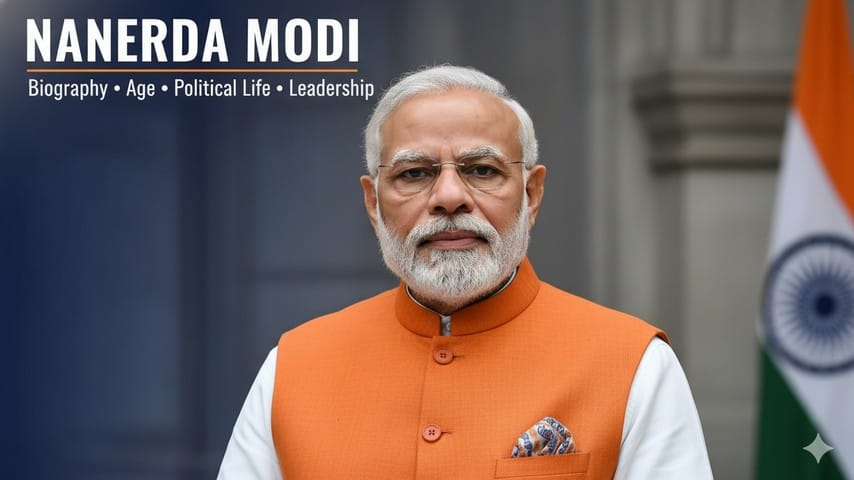
From an early age, he showed an interest in social service and spirituality. He became involved with the Rashtriya Swayamsevak Sangh (RSS), a volunteer organization promoting cultural and nationalistic ideals, which shaped much of his later political outlook.
Personal Information
| Information | Details |
|---|---|
| Full Name | Narendra Damodardas Modi |
| Date of Birth | 17 September 1950 |
| Age (as of 2025) | 75 years |
| Birthplace | Vadnagar, Gujarat, India |
| Nationality | Indian |
| Religion | Hinduism |
| Political Party | Bharatiya Janata Party (BJP) |
| Education | Gujarat University (Political Science) |
| Early Association | Rashtriya Swayamsevak Sangh (RSS) |
| Current Position | Prime Minister of India (since 2014) |
Political Journey
Early Political Work
Modi’s involvement in politics began through the RSS, where he worked as a pracharak (campaigner). His efficiency and discipline caught attention, and he was assigned to work with the Bharatiya Janata Party (BJP) in the 1980s. His organizational skills and ability to connect with grassroots workers helped him rise quickly within party ranks.
Chief Minister of Gujarat (2001–2014)
In 2001, Modi became the Chief Minister of Gujarat. His administration emphasized infrastructure, industry, and economic growth. Gujarat saw rapid urbanization and industrial development during his tenure. However, his leadership also faced criticism following the 2002 Gujarat riots, a controversial episode that continues to shadow his legacy.
Despite the criticism, he maintained strong electoral support, winning multiple state elections and positioning himself as a pro-development leader.
Prime Minister of India (2014–Present)
In 2014, Narendra Modi led the BJP to a historic victory, ending decades of coalition politics. His campaign emphasized development, digital modernization, and strong leadership.
He was re-elected in 2019 with an even larger mandate and secured a third consecutive term in 2024 under the National Democratic Alliance coalition. His tenure has been marked by a mix of bold reforms, centralized decision-making, and global outreach.
Major Achievements
- Economic Initiatives: Focus on infrastructure, manufacturing, and digital growth through programs like Make in India, Digital India, and Startup India.
- Social Reforms: Nationwide sanitation campaigns and schemes for financial inclusion.
- Global Diplomacy: Strengthened India’s ties with major world powers and enhanced its international profile.
- Leadership Style: Known for disciplined governance, powerful communication, and connecting with the masses.
Criticism and Controversies
While admired by many for his leadership and vision, Modi’s tenure has not been without controversy. Critics point to concerns over religious polarization, press freedom, and challenges in employment and income growth. The 2002 Gujarat riots remain one of the most debated chapters in his political career.
Personal Life
Modi’s life reflects simplicity and discipline. He follows a strict daily routine, often beginning his day early with yoga and meditation. Though deeply involved in politics, he maintains a minimalist lifestyle, emphasizing self-reliance and dedication to public service.
Key Takeaways
- Rose from humble beginnings to become one of India’s most powerful leaders.
- Served over a decade as Chief Minister of Gujarat before becoming Prime Minister.
- Transformed Indian politics through a focus on nationalism, development, and communication.
- Strengthened India’s global standing through active diplomacy.
- His leadership remains both highly influential and widely debated.
Frequently Asked Questions (FAQs)
Who is Narendra Modi?
He is the current Prime Minister of India, serving since 2014 and leading the Bharatiya Janata Party.
When was he born?
He was born on 17 September 1950 in Vadnagar, Gujarat.
What was his early occupation?
In his youth, he helped his father sell tea before joining the RSS.
When did he become Prime Minister?
He took office as Prime Minister on 26 May 2014.
How many terms has he served?
He is serving his third consecutive term as of 2025.
What are some key reforms under his government?
Economic modernization, infrastructure expansion, and digital governance have been central themes.
What are the main criticisms of his leadership?
Issues of communal polarization, press freedom, and economic inequality have drawn criticism from opponents and analysts.
Conclusion
Narendra Modi’s journey from a tea seller’s son in Gujarat to the Prime Minister of India is a remarkable story of determination and leadership. His governance has redefined India’s political and economic direction, fostering both admiration and debate.
Whether viewed as a visionary reformer or a divisive political figure, his impact on India’s modern identity is undeniable. His legacy combining development, nationalism, and strong central leadership will continue to influence Indian politics for generations to come.