
Sardar Vallabhbhai Patel Iron Man of India, Architect of Unity
Sardar Vallabhbhai Patel, known as the Iron Man of India, was a central figure in India’s freedom struggle and the country’s first Deputy Prime Minister and Home Minister. A close ally of Mahatma Gandhi, he played a decisive role in integrating more than 560 princely states into one nation after independence, earning him the title Architect of National Unity.
Patel’s firm leadership, administrative acumen, and unyielding patriotism made him one of the strongest pillars of India’s early governance. His courage, practicality, and discipline continue to symbolize unity and strength in modern India.
Early Life & Background
Vallabhbhai Jhaverbhai Patel was born on October 31, 1875, in Nadiad, Gujarat. His father, Jhaverbhai Patel, had served in the army of the Rani of Jhansi, and his mother, Ladba Patel, was known for her piety and strength of character.
Raised in a humble agrarian family, Patel displayed determination and intelligence from a young age. He completed his early studies in Karamsad and Petlad before pursuing law independently while working on the family farm.
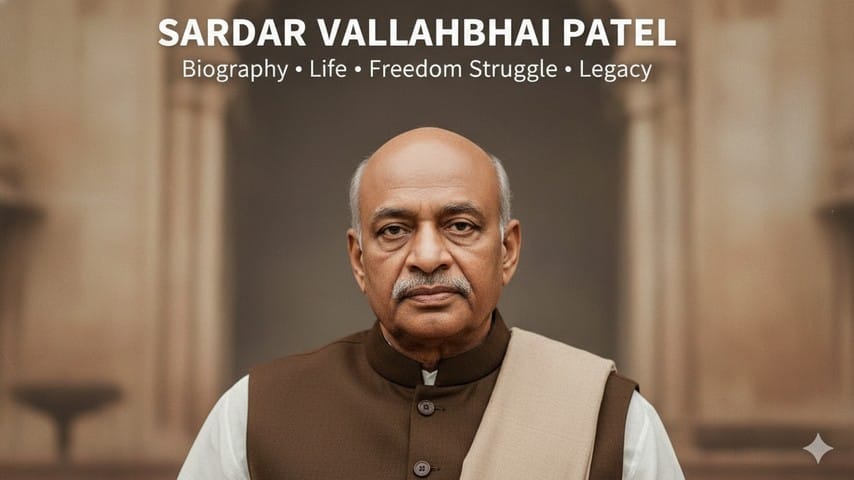
In 1910, he traveled to London to study law at the Middle Temple, where he excelled. Returning to India in 1913, he began a successful law practice in Ahmedabad and soon became known for his honesty and sharp intellect. Meeting Mahatma Gandhi later transformed his life, steering him toward public service and national struggle.
Personal Information
| Information | Details |
|---|---|
| Full Name | Vallabhbhai Jhaverbhai Patel |
| Popularly Known As | Sardar Vallabhbhai Patel, Iron Man of India |
| Profession | Lawyer, Freedom Fighter, Statesman |
| Date of Birth | October 31, 1875 |
| Birthplace | Nadiad, Gujarat, India |
| Nationality | Indian |
| Religion | Hinduism |
| Education | Law at Middle Temple, London |
| Father’s Name | Jhaverbhai Patel |
| Mother’s Name | Ladba Patel |
| Spouse | Jhaverba Patel |
| Children | Dahyabhai Patel, Maniben Patel |
| Political Affiliation | Indian National Congress |
| Positions Held | Deputy Prime Minister, Home Minister of India (1947–1950) |
| Date of Death | December 15, 1950 |
| Age at Death | 75 years |
| Place of Death | Bombay (now Mumbai), India |
| Famous For | Uniting princely states; leadership in independence movement |
| Titles | Iron Man of India, Architect of National Integration |
Career Journey & Freedom Struggle
Early Career as a Lawyer
After returning from London, Patel practiced law in Ahmedabad, quickly earning a reputation for fairness and integrity. Despite success, he was drawn toward public service, influenced by Gandhi’s call for national awakening.
Entry into Public Life
Patel’s political journey began when he led protests against a plague tax imposed by the British in Ahmedabad. His effective leadership brought him public recognition and established him as a strong voice for the people.
Kheda and Bardoli Satyagrahas
In 1918, Patel led the Kheda Satyagraha, helping farmers who could not pay taxes after poor harvests. His persistence and strategic leadership resulted in tax suspension, marking a major victory for civil rights.
In 1928, he led the Bardoli Satyagraha against increased land revenue. His disciplined approach and success earned him the title Sardar, meaning “leader.” This campaign cemented his national stature.
Role in the Indian National Congress
Patel was a vital member of the Congress Working Committee and a trusted aide of Gandhi. Known for his organizational skills and political pragmatism, he played a key role in mobilizing people and maintaining discipline within the party.
Role in India’s Independence Movement
Patel actively participated in all major movements for freedom — the Non-Cooperation Movement, Civil Disobedience Movement, and Quit India Movement. He endured multiple imprisonments, each time returning with renewed strength.
By the 1940s, Patel had become one of the most respected leaders in the country and a central figure in Congress leadership.
Architect of a United India
After independence in 1947, India faced the enormous challenge of unifying 562 princely states that were free to join either India or Pakistan or remain independent.
As Deputy Prime Minister and Home Minister, Patel led this mission with diplomacy and determination. Through negotiation, persuasion, and, when necessary, firm action — as seen in Hyderabad and Junagadh — he succeeded in integrating all states into a single nation.
This unparalleled achievement made him the Iron Man of India, ensuring India’s unity and stability at its most critical juncture.
Achievements & Milestones
| Year | Event / Achievement |
|---|---|
| 1918 | Led Kheda Satyagraha for farmers’ tax relief |
| 1928 | Led Bardoli Satyagraha; earned the title “Sardar” |
| 1931 | Presided over the Karachi Session of the Indian National Congress |
| 1942 | Imprisoned during Quit India Movement |
| 1947 | Became India’s first Deputy Prime Minister and Home Minister |
| 1947–49 | Integrated 562 princely states into the Indian Union |
| 1948 | Oversaw Hyderabad’s accession through Operation Polo |
| 1950 | Passed away in Bombay on December 15 |
| 2018 | Statue of Unity inaugurated in Gujarat in his honor |
Philosophy & Leadership Style
Patel was admired for his discipline, decisiveness, and sense of duty. He believed that strong governance and unity were essential for India’s progress.
His principles included:
- National Integrity: A united India was essential for strength and peace.
- Law and Order: Stability was the foundation for growth.
- Self-Reliance: Citizens must contribute to nation-building.
- Moral Courage: True leadership comes from conviction and honesty.
“My only desire is that India should be a good producer and no one should be hungry, shedding tears for food.”
Personal Life & Character
Sardar Patel married Jhaverba Patel, who passed away early, leaving him to raise their two children. Despite personal loss, he remained devoted to duty.
Behind his stern exterior, Patel was warm, humorous, and compassionate. His simple lifestyle reflected humility and service to the nation.
Legacy & Commemoration
Sardar Vallabhbhai Patel passed away on December 15, 1950. His death was a great loss to the newly independent nation.
In 2018, the Statue of Unity — the world’s tallest statue at 182 meters — was inaugurated in Kevadia, Gujarat, as a tribute to his unparalleled contribution. His birthday, October 31, is observed as National Unity Day (Rashtriya Ekta Diwas).
His vision of a strong, unified India continues to guide national policy and governance.
Key Takeaways
- First Deputy Prime Minister and Home Minister of India
- Known as the Iron Man of India for his firmness and integrity
- United over 560 princely states into one nation
- Led historic movements like Kheda and Bardoli Satyagrahas
- Advocated strong governance, unity, and discipline
- His leadership built the foundation for modern India’s unity
- Honored with the Statue of Unity, the tallest statue in the world
Frequently Asked Questions (FAQs)
Who was Sardar Vallabhbhai Patel?
A leader of India’s freedom movement and the first Deputy Prime Minister and Home Minister of independent India.
Why is Patel called the Iron Man of India?
For his strength, courage, and unwavering resolve in uniting India’s princely states.
When and where was he born?
October 31, 1875, in Nadiad, Gujarat, India.
Which movement earned him the title Sardar?
The Bardoli Satyagraha of 1928.
What was his major contribution after independence?
He unified 562 princely states into the Indian Union.
When did Sardar Patel die?
December 15, 1950, in Bombay (Mumbai).
What honors commemorate him today?
The Statue of Unity and National Unity Day celebrated on his birth anniversary.
Conclusion
Sardar Vallabhbhai Patel’s life reflects strength, vision, and commitment to national service. From a humble lawyer to the Iron Man of India, he shaped the destiny of a new nation through courage and unity.
His success in unifying India’s diverse princely states stands as one of the greatest political accomplishments in history. Patel’s leadership laid the foundations for modern India, reminding generations that true power lies in unity, discipline, and unwavering devotion to the nation.