
Mahatma Gandhi Life, Philosophy & Legacy
Mahatma Gandhi remains one of history’s most influential leaders, remembered for his philosophy of nonviolence (Ahimsa), his commitment to truth (Satya), and his leadership in India’s struggle for independence. His teachings inspired peace and civil rights movements across the world, influencing leaders like Martin Luther King Jr., Nelson Mandela, and the Dalai Lama.
Beyond politics, Gandhi’s message of simplicity, self-reliance, and moral integrity continues to guide generations. His life story reflects not only a nation’s fight for freedom but also a universal lesson in courage and humanity.
Early Life & Background
Mohandas Karamchand Gandhi was born on October 2, 1869, in Porbandar, Gujarat, India. His father, Karamchand Gandhi, served as chief minister of Porbandar, while his mother, Putlibai, was deeply religious and instilled in him values of truth and compassion.
Raised in a Vaishnav Hindu household, Gandhi grew up learning respect for all religions and living beings. In 1883, he married Kasturba Makhanji at the age of 13. The couple had four sons and shared a lifelong partnership rooted in love and social activism.
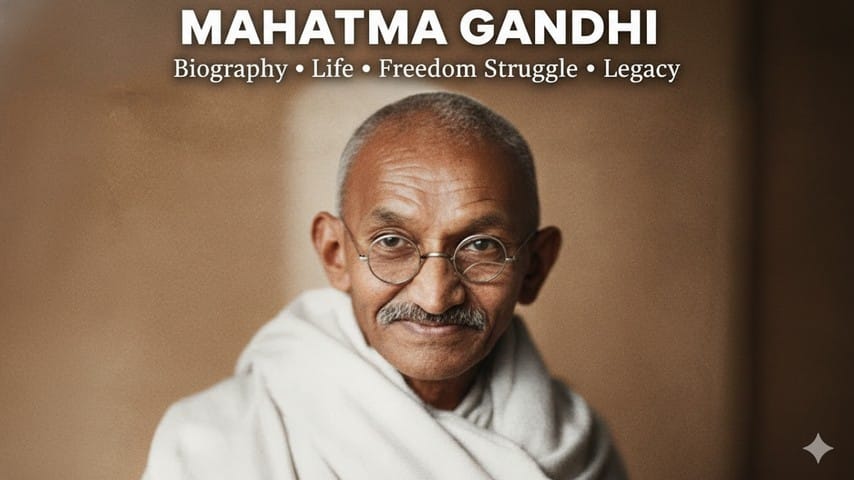
At 18, Gandhi traveled to London to study law at the Inner Temple. His time there exposed him to Western thought and writers like Tolstoy and Ruskin, who influenced his later philosophies of truth, simplicity, and nonviolence.
Personal Information Table
| Information | Details |
|---|---|
| Full Name | Mohandas Karamchand Gandhi |
| Popularly Known As | Mahatma Gandhi, Bapu |
| Profession | Lawyer, Political Leader, Social Reformer |
| Date of Birth | October 2, 1869 |
| Birthplace | Porbandar, Gujarat, India |
| Nationality | Indian |
| Religion | Hinduism, influenced by Jain and interfaith values |
| Education | Law at Inner Temple, London |
| Father’s Name | Karamchand Gandhi |
| Mother’s Name | Putlibai Gandhi |
| Spouse | Kasturba Gandhi |
| Children | Harilal, Manilal, Ramdas, Devdas |
| Date of Death | January 30, 1948 |
| Age at Death | 78 years |
| Death Place | New Delhi, India |
| Cause of Death | Assassination |
| Famous For | Leading India’s nonviolent independence movement |
| Major Ideals | Ahimsa, Satya, Satyagraha, Sarvodaya |
Career Journey & Freedom Struggle
Early Professional Life in London & South Africa
After earning his law degree, Gandhi briefly practiced in India before moving to South Africa in 1893 for legal work. There, he faced racial discrimination, including being ejected from a train despite holding a first-class ticket. This incident ignited his resolve to fight injustice.
He founded the Natal Indian Congress in 1894 to defend Indian rights and developed his concept of Satyagraha — peaceful resistance founded on truth and nonviolence. His campaigns in South Africa earned him recognition as a moral and political leader.
Return to India & Rise as a National Leader
Returning to India in 1915, Gandhi dedicated himself to understanding rural issues and uplifting the poor. His early movements, including Champaran (1917) and Kheda (1918), fought for peasants’ rights and marked the beginning of his national leadership.
He later led major campaigns such as:
- Non-Cooperation Movement (1920–22) — boycotting British goods and institutions
- Salt March (1930) — protesting the British salt tax through a 240-mile march to Dandi
- Quit India Movement (1942) — demanding immediate British withdrawal from India
These movements demonstrated his unwavering belief that moral strength could defeat imperial power.
Imprisonment & Challenges
Gandhi spent over 2,000 days in prison for his activism. Yet, imprisonment became a time of introspection and writing. His faith in nonviolence never wavered, even amid political disagreements and social unrest.
Rise to Global Prominence
Gandhi’s influence spread far beyond India. His philosophy of peaceful resistance inspired movements worldwide. Leaders like Martin Luther King Jr. and Nelson Mandela adopted his principles in their struggles against injustice.
Through his writings, speeches, and moral leadership, Gandhi became a symbol of peaceful defiance and ethical politics across the world.
Achievements & Milestones
| Year | Achievement / Event |
|---|---|
| 1893 | Faced racial discrimination in South Africa, began civil rights activism |
| 1894 | Founded Natal Indian Congress |
| 1906 | Formulated Satyagraha philosophy |
| 1915 | Returned to India, joined Indian National Congress |
| 1917–1918 | Led Champaran and Kheda peasant movements |
| 1920–1922 | Led Non-Cooperation Movement |
| 1930 | Conducted the Salt March to Dandi |
| 1931 | Attended Second Round Table Conference in London |
| 1942 | Launched Quit India Movement |
| 1947 | Witnessed India’s independence |
| 1948 | Assassinated in New Delhi on January 30 |
Ideology & Principles
Gandhi’s teachings centered on ethical living and peaceful resistance:
- Ahimsa: Nonviolence in thought, word, and action
- Satya: Commitment to truth in all circumstances
- Satyagraha: Moral strength through peaceful protest
- Sarvodaya: Welfare and equality for all
- Swadeshi: Self-reliance through use of local goods
- Religious Harmony: Respect and unity among faiths
His simple lifestyle — spinning khadi, vegetarianism, and living in ashrams — reflected his dedication to equality and humility.
Personal Life & Legacy
Gandhi’s partnership with Kasturba Gandhi was built on shared activism and mutual respect. After India gained independence in 1947, he worked to ease communal tensions between Hindus and Muslims during partition.
He was assassinated on January 30, 1948, by Nathuram Godse while attending a prayer meeting. His last words, “Hey Ram,” expressed his enduring faith and peace.
Influence on the World
Gandhi’s message shaped the global conscience. His philosophy inspired nonviolent movements from the American civil rights struggle to South Africa’s anti-apartheid campaign.
The United Nations honors his legacy by observing October 2 as the International Day of Non-Violence.
Key Takeaways
- Gandhi led India’s independence through peaceful resistance.
- His core ideals — truth, nonviolence, and self-reliance — influenced global civil rights movements.
- He founded the principles of Satyagraha and Sarvodaya for social harmony.
- Gandhi’s simple life embodied his spiritual and ethical values.
- His moral leadership continues to inspire peace, justice, and human dignity.
Frequently Asked Questions (FAQs)
Who was Mahatma Gandhi?
An Indian leader, lawyer, and reformer who led India’s independence movement through nonviolent methods.
What was his main philosophy?
Truth (Satya) and nonviolence (Ahimsa) as the guiding principles of life and resistance.
When and where was he born?
October 2, 1869, in Porbandar, Gujarat, India.
Why is he called Mahatma?
“Mahatma,” meaning “Great Soul,” was a title given by Rabindranath Tagore in honor of his moral greatness.
What were his major movements?
Non-Cooperation, Salt March, and Quit India Movement.
When did he die?
January 30, 1948, in New Delhi.
What is his legacy?
His teachings continue to shape peace and justice movements around the world.
Conclusion
Mahatma Gandhi’s life stands as a monument to truth, compassion, and the power of peaceful resistance. From his humble beginnings to leading one of the greatest freedom movements in history, he proved that moral courage can transform the world.
His ideals transcend time and borders, reminding humanity that true strength lies not in violence but in love, truth, and perseverance. Gandhi’s message remains a guiding light for anyone seeking justice through peace.