
Frank Gehry Biography, Architectural Vision & Legacy
Introduction
Frank Gehry was a visionary architect and designer whose daring sculptural buildings redefined contemporary architecture. Known for his bold curves, unconventional materials and striking creativity, Gehry’s works such as the Guggenheim Museum Bilbao in Spain and the Walt Disney Concert Hall in Los Angeles transformed city skylines and influenced generations of architects worldwide. His career spanned decades, blending architecture, art, design, and innovation, earning him the status of one of the most influential architects of the late twentieth and early twenty first centuries.
Early Life & Background
Frank Gehry was born on February 28, 1929, in Toronto, Ontario, Canada. His birth name was Frank Owen Goldberg. In 1947, as a teenager, he and his family moved to Los Angeles, California.
He studied architecture at the University of Southern California, graduating in 1954. He briefly furthered his studies in city planning at the Harvard Graduate School of Design before eventually returning to Los Angeles to begin his architectural career.
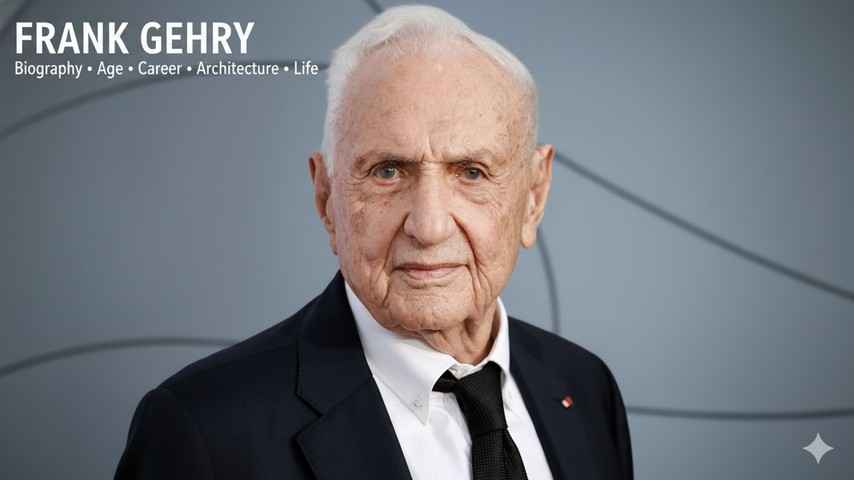
In 1954, he changed his surname from Goldberg to Gehry, influenced by concerns over antisemitism and to help his professional prospects.
These early years, moving from Canada to the United States, formal architectural training, and immersion in the cultural environment of mid century Los Angeles, laid the groundwork for his later innovative approach to architecture.
Personal Information Table
| Information | Details |
|---|---|
| Full Name | Frank Owen Gehry (born Frank Owen Goldberg) |
| Profession | Architect, Designer |
| Date of Birth | February 28, 1929 |
| Date of Death | December 5, 2025 |
| Birthplace | Toronto, Ontario, Canada |
| Nationality | Canadian, later U.S. Citizen |
| Education | B.Arch from University of Southern California, studied City Planning at Harvard Graduate School of Design |
| Architectural Practice | Founded own firm in Los Angeles (Frank O. Gehry & Associates, later Gehry Partners) |
| Signature Style | Sculptural, deconstructivist or postmodern architecture, use of unconventional forms and materials like titanium, stainless steel, and undulating structures |
| Notable Works | Guggenheim Museum Bilbao, Walt Disney Concert Hall, Vitra Design Museum, Fondation Louis Vuitton, Jay Pritzker Pavilion |
| Legacy or Recognition | Pritzker Architecture Prize 1989, global influence, considered one of the most important contemporary architects |
Career Journey
Early Career & First Studio
After finishing his studies, Gehry worked for established firms in Los Angeles and Paris, gaining experience before starting his own practice.
In 1962, he founded his own agency (later known as Gehry Partners), marking the beginning of his independent architectural identity.
During his early career, Gehry experimented with residential and small scale projects, gradually developing a distinctive aesthetic sensibility that combined raw materials and artistic impulse.
Breakthrough: Deconstructivism & Experimental Style
A pivotal moment came in 1978, when Gehry dramatically renovated his own Santa Monica residence. He transformed a modest bungalow into an experimental house using corrugated metal, chain link fencing, plywood and unconventional materials, effectively announcing his radical style to the world.
This personal project signaled his break from traditional architecture and aligned him with a new wave of creative experimentation, merging architecture with sculptural art.
Global Recognition: Major Landmark Projects
From the 1980s and beyond, Gehry’s reputation blossomed internationally. He became renowned for designing buildings that looked more like sculptures than conventional structures, often using metal cladding, flowing shapes, and innovative forms.
Perhaps his most famous work is the Guggenheim Museum Bilbao (completed in 1997). The museum’s swirling titanium clad forms combined with stone volumes created a breathtaking and iconic architectural landmark, widely regarded as a masterpiece of contemporary architecture.
Other major works include the Walt Disney Concert Hall in Los Angeles and the Fondation Louis Vuitton in Paris. Gehry’s career extended across continents and building types, from museums and concert halls to urban complexes and residential towers.
Innovation & Digital Design Methods
In the 1990s, Gehry pioneered the use of advanced digital design and modeling technology in architecture. He and his firm adopted software originally developed for aerospace engineering to design and fabricate complex, curvilinear structures that would have been extremely difficult with traditional drafting methods.
This shift enabled unprecedented freedom in architectural form and set a precedent for digital architecture and parametric design, influencing how modern buildings are conceived and constructed.
Rise to Fame & Influence
Gehry’s rise was gradual but impactful. Starting from modest beginnings, his 1978 Santa Monica house renovation marked his bold departure from traditional architecture. From there, his experimental style caught attention, leading to commissions worldwide.
The opening of the Guggenheim Museum Bilbao in 1997 was a watershed moment not just for Gehry’s career but for architecture itself. The building’s success helped spark what is often called the Bilbao Effect, the phenomenon where a high profile architectural landmark revitalizes a city culturally, economically, and visually.
Through subsequent projects across Europe, North America and beyond, Gehry established himself as the defining architect of his generation. His influence extended beyond buildings, helping reshape how architects think about materials, form, engineering, and the integration of technology and art in architecture.
Notable Works & Architectural Highlights
- Guggenheim Museum Bilbao, Spain – Titanium clad sculptural museum (1997)
- Walt Disney Concert Hall, Los Angeles – Landmark concert hall characterized by sweeping metallic curves (completed 2003)
- Vitra Design Museum, Germany – European museum project showcasing his distinctive deconstructivist style
- Fondation Louis Vuitton, Paris – Cultural institution with Gehry’s signature expressive forms
- Jay Pritzker Pavilion, Chicago’s Millennium Park – A celebrated public performance space combining architectural boldness with civic function
- Museum of Pop Culture, Seattle – An example of how his style adapted to cultural institutions beyond traditional museums
Beyond buildings, Gehry also ventured into furniture and product design, including the Easy Edges chairs featured in the Museum of Modern Art in New York.
Architectural Style & Philosophy
Frank Gehry’s work is often described as deconstructivist or postmodern, though he resisted strict labels.
He treated buildings as sculptural objects where form, light, materials, and human experience converge.
A hallmark of his style was breaking away from traditional right angles and rectilinear geometry. Instead, his designs often featured flowing curves, fragmented shapes, and unexpected forms, making structures that looked alive, dynamic, and emotionally expressive.
Technologically, he embraced computer aided design and digital fabrication early on, using tools to translate complex geometry into buildable structures. This integration of art and technology broadened architectural possibilities and influenced future generations.
Yet, beneath the bold visuals, Gehry often maintained pragmatic concerns, ensuring structural integrity, functionality, and sometimes even modesty when required.
Achievements & Recognition
Gehry’s contributions earned him the highest honors in architecture and beyond, including the Pritzker Architecture Prize in 1989. He completed numerous global commissions and landmark projects that helped define modern architecture’s direction and earned recognition as one of the most transformative figures of his time.
Personal Life & Later Years
Over his long career, Gehry lived mostly in Los Angeles since moving there in 1947.
He directed his firm, mentored younger architects, and maintained a willingness to experiment even late into his career. Gehry often expressed that he saw architecture as art and believed in pushing boundaries rather than adhering to orthodoxy.
Frank Gehry passed away on December 5, 2025, at his home in Santa Monica, California, at the age of 96.
Key Takeaways
- Frank Gehry transformed architecture by treating buildings as sculptural, expressive art rather than mere functional boxes.
- His radical use of curves, metal, unconventional forms and digital design reshaped expectations for what buildings could look like.
- With works like the Guggenheim Museum Bilbao and Walt Disney Concert Hall, he created global landmarks that fused architecture, art, and cultural identity.
- Gehry embraced technology to make previously impossible shapes buildable, influencing modern architecture’s direction.
- His legacy lives not only in his iconic buildings, but in the freedom he gave to architects worldwide to experiment, dream, and redefine space.
Frequently Asked Questions (FAQs)
Who was Frank Gehry?
Frank Gehry was a Canadian American architect and designer, widely regarded as one of the most influential architects of modern times, renowned for his sculptural, unconventional, and expressive buildings.
When and where was Frank Gehry born?
He was born on February 28, 1929, in Toronto, Ontario, Canada.
What style of architecture is Gehry known for?
Gehry is known for postmodern or deconstructivist architecture featuring free form, sculptural buildings with bold curves, unconventional materials, and dynamic forms.
What are some of his most famous buildings?
Some of his most famous buildings include the Guggenheim Museum Bilbao, Walt Disney Concert Hall, Fondation Louis Vuitton, Vitra Design Museum, and Jay Pritzker Pavilion.
What major award did he win?
He won the Pritzker Architecture Prize in 1989, one of the highest honors in architecture.
Why is the Guggenheim Museum Bilbao significant?
The Guggenheim Museum Bilbao is considered a turning point in contemporary architecture. Its swirling titanium clad design became an iconic symbol of bold architectural expression and helped launch the Bilbao Effect, showing how a landmark building can revitalize a city culturally and economically.
How did Gehry influence modern architecture?
He pioneered the integration of digital design tools with architecture, enabling complex geometries and sculptural forms. His success challenged architects to think beyond straight lines and traditional styles, influencing a generation to see architecture as expressive art.
When did Frank Gehry pass away?
Frank Gehry passed away on December 5, 2025 in Santa Monica, California, at age 96.
Conclusion
Frank Gehry’s architectural journey was marked by fearless innovation, artistic daring, and a profound reimagination of what buildings can be. From a young immigrant in Los Angeles to a world renowned architect, Gehry challenged conventions, merged art with architecture, and used technology to realize visionary forms. His buildings are more than structures, they are sculptures, landmarks, experiences. As the world bids farewell to him in 2025, his legacy endures, a legacy of creativity, bold vision, and the belief that architecture can be as expressive and alive as any work of art.